March 2026
Mobility Myopia: Why Houston Must Think Bigger About Transportation Investment

This article was written by METRO's Chief Financial Officer George Fotinos.
In business school, the Harvard Business Review article, “Marketing Myopia” is taught. The standard text teaches that being short-sighted about your business is folly. Businesses miss huge opportunities when they act as such. The core idea is simple: when organizations define themselves too narrowly, they limit their ability to grow, innovate, and respond to changing markets. The version I read in business school in the early 2000’s cited the example of Xerox missing the opportunity of being the first mover on the personal computer market. They were very well positioned but because they deemed themselves a copy machine company, they never saw what is abundantly obvious in hindsight. Had they viewed themselves more broadly as a technology company, they could have held a significant advantage in a groundbreaking market.
I think of this business lesson often when I share my thoughts about METRO. Today’s strongest organizations define themselves by the problem they solve, not the product they sell. Modern companies that take this lesson seriously adopt a wider, longer-term perspective. For example, Coca-Cola has been referenced as a hydration company. It sells colas, but it also sells water, fruit drinks, and other beverages.
METRO offers mass transit via buses and light-rail. It also offers paratransit for people who cannot use fixed-route service due to a disability. It has a commuter vanpool program for those who want a break from driving. More recently, METRO has expanded into flexible, individual-focused mobility options such as microtransit, meeting people where they are as travel habits evolve.
The range of METRO services has a common denominator: moving people. But that’s still only part of it. METRO paves streets, performs utility work, builds sidewalks, bus stops, operates HOV lanes and even repairs potholes. At first glance, that surprises people. Why would a transit agency be fixing streets?
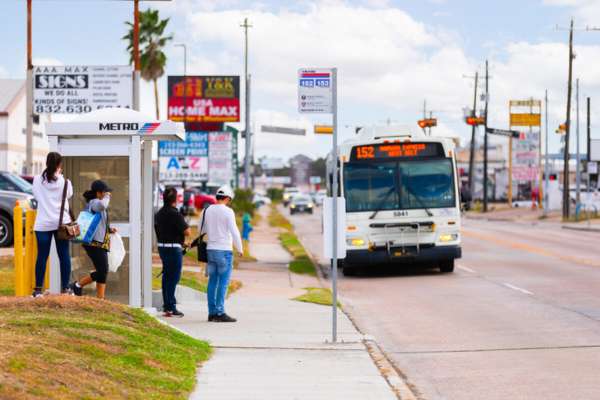
METRO doesn’t just move people; it helps make it easier and safer for people moving. Mobility doesn’t begin when someone steps onto a bus or train. It begins when they leave their front door, cross a sidewalk, navigate an intersection, and safely reach a stop or station. If that journey is unsafe, unreliable, or congested, the transit system suffers too.
The street work METRO performs is necessary for operating transit. Transit engineers will tell you that building a new transit corridor involves extensive street work including utilities, paving, and drainage. Fleet teams will tell you that buses operating on rough roads experience greater wear and shorter lifespans. Riders will tell you the ride quality suffers as well. Smoother streets improve reliability, extend asset life, and reduce long-term maintenance costs. That’s good business.
In many cases, this street work extends beyond transit operations and supports overall mobility across the region. When voters in the METRO service area weighed in through various referendums, they supported using METRO resources for road repair and mobility services. This is why approximately one-fourth of METRO’s sales and use tax revenue is distributed to its 16 partner jurisdictions, including the City of Houston and unincorporated Harris County. This is a deliberate investment strategy. METRO chooses to reinvest locally because strong partnerships and healthy infrastructure benefit the entire regional economy.
This funding mechanism, known as the General Mobility Program, supports infrastructure and congestion mitigation projects carried out by partner jurisdictions. Through these shared investments, cities improve drainage, so roads stay passable after storms, rehabilitate concrete and asphalt streets, repair sidewalks to improve safety and accessibility, upgrade traffic signals to reduce congestion, and enhance roadway lighting. These improvements directly affect how employees get to work, how goods move through the region, how neighborhoods stay connected, and how businesses remain competitive. These activities can also include traffic enforcement coordination and road construction. In the end, it all supports regional mobility. And it all comes from METRO.
If METRO were thought of solely as a mass transit agency, that would be incomplete. I prefer to think of METRO as a mobility organization. That distinction matters. Mobility supports workforce access, regional growth, property development, safety, and quality of life. It supports how Houston functions as a global city. And I don’t think METRO always gets credit for that role. But the lesson from “Marketing Myopia” remains relevant as we envision METRO’s future and the opportunities ahead. When we broaden how we define transportation, we unlock smarter investments, stronger partnerships, and better outcomes for the entire region.

 Google Chrome
 Safari Mac OS
 Mozilla
 Microsoft Edge